
Blog Details
- Member
- March 1, 2026
Technology and Demand Forecast of Magnetic Levitation Motors
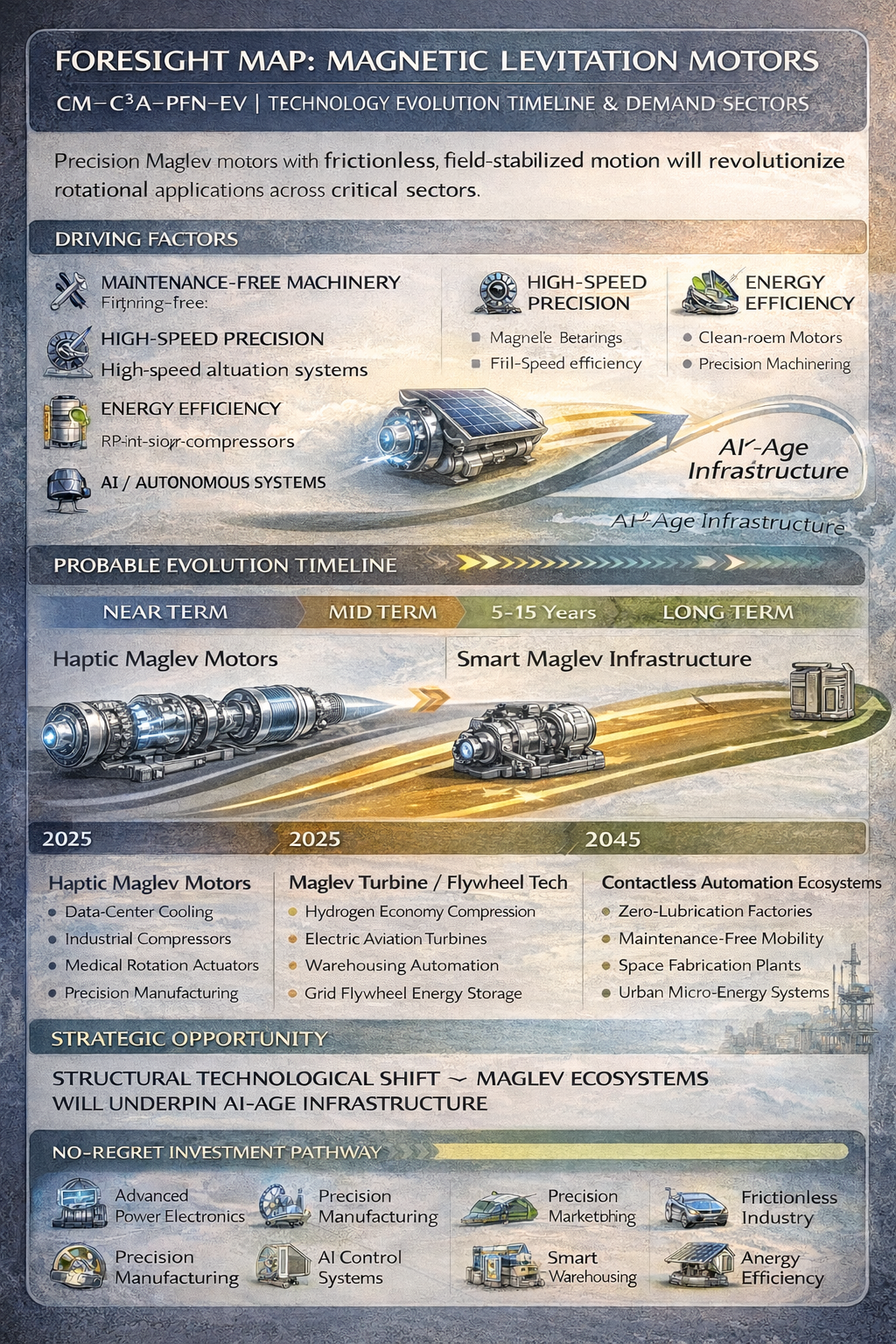
Srijan Sanchar Foresight on Magnetic levitation motors represent a decisive transition in the evolution of rotating machinery from mechanical contact–based motion toward field-controlled motion systems. Conventional motors rely on physical bearings that inevitably introduce friction, vibration, lubrication requirements, wear, and maintenance cycles. Magnetic levitation eliminates mechanical contact by suspending the rotor within controlled electromagnetic fields, allowing rotation to occur without physical resistance. This seemingly technical shift fundamentally changes how machines operate, extending operational life, improving efficiency, and enabling continuous high-speed performance that traditional bearing systems struggle to sustain.
The growing relevance of magnetic levitation motors is closely linked to the emergence of infrastructure where reliability and uninterrupted operation have become economically critical. AI data centers, semiconductor fabrication facilities, precision manufacturing environments, and advanced cooling systems increasingly operate under conditions where even minor downtime produces disproportionate losses. In such environments, maintenance-free operation becomes more valuable than incremental gains in efficiency. Maglev motors respond directly to this need by minimizing mechanical degradation, reducing vibration, and enabling stable operation at extremely high rotational speeds while maintaining low noise and thermal losses.
A major technological consequence of this transition is the gradual movement from classical machine engineering toward electromagnetically stabilized intelligent systems. The motor is no longer merely a rotating device but becomes an actively controlled dynamic system integrating sensors, power electronics, and digital control algorithms. Stability, efficiency, and performance are governed through software-driven magnetic control rather than mechanical tolerances alone. This convergence aligns naturally with advances in artificial intelligence, embedded sensing, and predictive diagnostics, allowing machines to monitor their own behavior and adjust operating conditions in real time.
Industrial demand is expected to expand first in sectors already dependent on high-speed compressors, vacuum pumps, and advanced HVAC systems, where magnetic levitation significantly reduces lifecycle costs. As electrification deepens across economies, hydrogen compression systems, energy storage flywheels, and next-generation mobility platforms are likely to adopt frictionless rotational technologies to improve efficiency and reliability. Autonomous logistics systems, electric aviation subsystems, and sealed manufacturing environments further strengthen the case for contactless motion technologies capable of operating for long durations without intervention.
Commercial viability is increasingly supported by improvements in power electronics, digital controllers, and advanced magnetic materials, which are steadily reducing system complexity and cost barriers. While initial capital investment remains higher than conventional motors, lifecycle economics favor maglev systems due to reduced maintenance, longer operational life, and lower energy consumption. As deployment volumes grow across cooling infrastructure and industrial automation, scale effects are expected to accelerate adoption and normalize costs.
Over time, magnetic levitation motors may enable an entirely new class of machines characterized by silent operation, minimal mechanical wear, and near-continuous functionality. Industrial systems could evolve toward sealed, contamination-free architectures requiring little lubrication or human intervention. Such systems are particularly relevant for future smart factories, urban infrastructure, and distributed energy networks where resilience and operational continuity are paramount.
In this emerging landscape, magnetic levitation motors are not simply improved electric motors but foundational enablers of frictionless industrial ecosystems. Their adoption signals a broader transformation in engineering philosophy—from managing mechanical limitations to designing controlled electromagnetic environments in which motion occurs with precision, efficiency, and durability previously unattainable.